News
Arts & Sciences
Health & Wellness
Culinary
Arts & Sciences
Teaching & Transformation: Nimra Farooqui’s MAT Journey
Life can take us in unexpected directions. Nimra Farooqui’s journey to attend JWU may have been sparked by her passion for cooking and baking — with a particular interest in the culturally-appropriate use of spices, herbs and boosting flavors — but her experience deepened when she discovered JWU’s Master of Arts in Teaching (MAT) in culinary arts education. “I saw it as a way to grow — not just as a chef, but as a person,” she explained. “The first semester was one of the hardest periods of my life. By the time I reached my later semesters, I had grown into someone who could stand in front of a classroom and lead with confidence.”
Farooqui began her formal culinary training in India and completed her bachelor’s degree in 2023, with her J1 program in Idaho commencing later that same year; she is on track to graduate with her MAT this May. How she grew and changed during her time at JWU is something she has reflected on with great thoughtfulness below. From growing up in a food-loving Indian household to taking on an exchange program in Idaho, follow the twists and turns of her inspiring journey — and her evolution from a shy newcomer into a culinary leader.
If you are interested in JWU’s MAT program, Farooqui discusses the program’s value at length, as well as how it’s broadened the way she thinks of herself and her goals. As she put it, “The MAT program is not just about teaching — it is about transformation.”
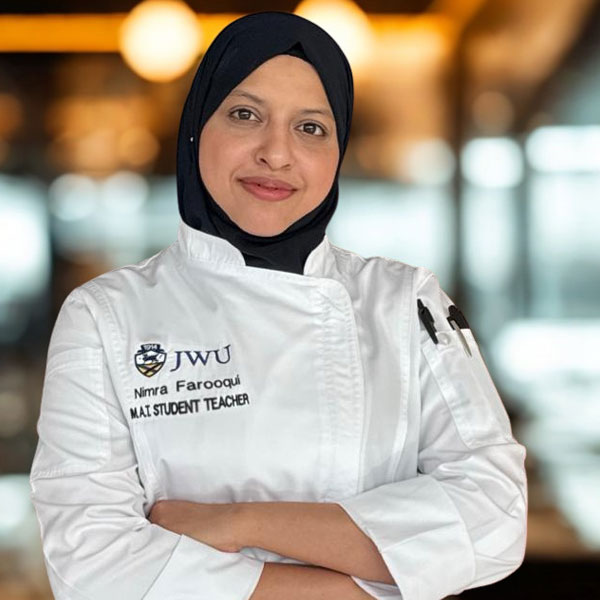 Did you grow up cooking? If so, tell me about an “a-ha!” moment when you knew you wanted to pursue baking professionally?
Growing up in an Indian household, I was surrounded by spices — not just as ingredients but as stories. I learned where they come from, how they are grown, and how they transform a dish. Indian cooking taught me patience and that flavor develops over time, through slow cooking and intention.
My mother was my first teacher. She was not a trained chef, but she was an incredible educator. She believed that before you learn recipes, you must learn how ingredients speak. I was in sixth grade when she imparted my very first lesson, not about a dish but about flavors. She placed salt, sugar, lemon juice, and a sip of black coffee in front of me and asked me to taste each one carefully. That was when I learned that food is about balance, contrast and emotion — not just cooking.
The moment that genuinely remained with me occurred when we prepared nankhatai, a traditional Indian cookie, without the use of an oven. We didn’t have one. Instead, my mother built an oven using a deep pot, layering it with sand and stones, preheating it for an hour, and baking the cookies inside. As a child, I had seen baking on television, but I had never experienced something like this process before. It felt magical. It showed me that limitations do not define creativity.
At that time, I didn’t yet know I wanted to become a pastry chef. However, I felt a profound connection to the process of transforming nothing into something. My favorite dish to make was lemon rice, made from leftover rice, peanuts, turmeric, green chilies and lemon juice — it taught me that even the simplest food can carry comfort, memory, and identity.
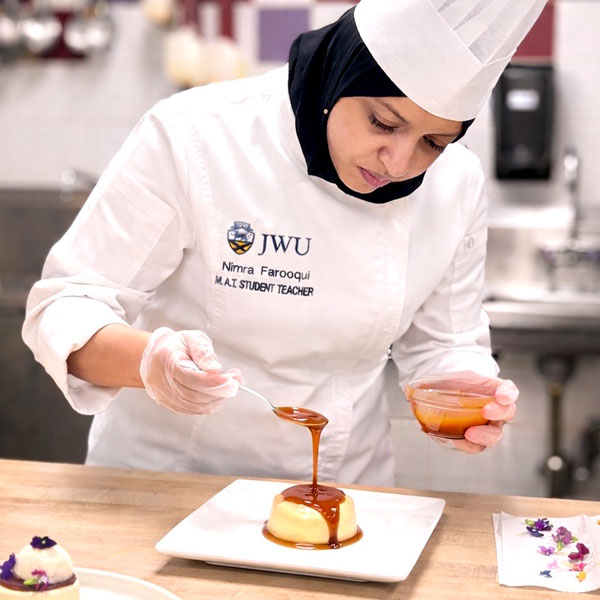 How did you choose JWU’s baking & pastry arts program? It’s such a big decision — and a long way to travel. What factors convinced you JWU was the right place for you?
I completed my first bachelor’s degree in commerce. It was not a choice driven by passion — it was something I pursued because it was expected of me. I come from a traditional and conservative family, where stability and convention were valued. Thinking “outside the box” was not something that came easily — or was even encouraged.
Even though I completed my degree, I knew I wanted to do something creative and meaningful — something that felt like me.
Coming to the United States was not an easy decision; it was a life-changing one. I was the first person in my family to even think about stepping out of the country.
Convincing my family to let me pursue culinary education was one of the hardest things I’ve ever done. It took six months of conversations, persistence and emotional strength to finally gain their trust and permission to move to another city.
But I believed in what I wanted. When I entered culinary school, it felt like I had found my place. Everything I had learned from my mother suddenly made sense in a professional context. I began to understand food not just emotionally, but technically and creatively.
[In 2023], I came to the U.S. through a cultural exchange program and worked in Idaho at a resort. It was a completely new environment for me — new culture, new people and new expectations. That experience shaped me in ways I never imagined.
At the resort, I worked with chefs who were JWU graduates. Their knowledge, discipline, and confidence stood out immediately. They didn’t just cook; they understood food at a deeper level. They encouraged me to explore JWU.
When I started researching, I realized that JWU was not just about culinary excellence — it was about leadership, education and growth. I initially searched for a master’s in pastry, but when I discovered the MAT, something shifted in me. It felt like an opportunity to combine my passion for food with something even more meaningful, impacting others.
“I saw the program as a way to grow — not just as a chef, but as a person. By the time I reached my later semesters, I had grown into someone who could stand in front of a classroom and lead with confidence.”
What made you decide to pursue the MAT at JWU?
If someone had asked me earlier in life if I wanted to become a teacher, my answer would have been NO. I was shy. I was afraid of public speaking. I doubted myself constantly.
But life has a way of putting you in situations that reveal who you are. During my time in Idaho, I was given the responsibility of training junior staff. At first, I was nervous. But as I started teaching them, I realized something surprising: I enjoyed it. More importantly, I was good at it. My chefs noticed this and gave me feedback that changed my perspective. They told me that I had the ability to explain concepts clearly and connect with people. That moment planted a seed.
Tell us what the MAT coursework sequence is like.
In the beginning, the program focuses on understanding students — their backgrounds, cultures and experiences. As an international student, I saw myself in that process. I understood what it feels like to be different, to struggle, to adapt. The program then builds on that foundation:
- Creating lesson plans
- Designing inclusive learning environments
- Practicing teaching strategies
- Reflecting and improving continuously
Talk about the most rewarding aspects of working alongside the same cohort group throughout your studies.
My cohort became my second family. We were a small group, but we supported each other through everything — assignments, presentations, challenges and personal growth.
One moment I’ll never forget is when I had to present in front of the class. I was extremely nervous, and I doubted myself. My peers didn’t let me give up. They practiced with me, gave me feedback, encouraged me, and stood by me until I felt ready. That experience taught me the power of community. They always respected me, my culture and my background and never let me give up. My professors also played a great role, and it was rewarding as well.
What does your fieldwork/in-person teaching portion of the program entail? (For example, developing lesson plans, implementing project-based learning, etc.)
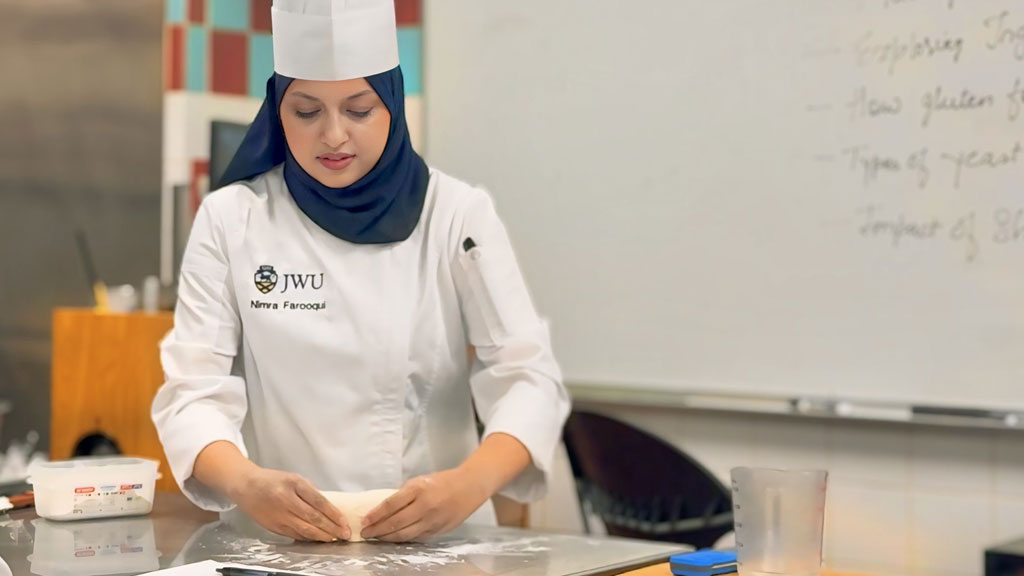
Fieldwork, for me, has been the moment where you stop thinking like a student and start thinking like an educator. It begins with observation, watching experienced instructors, not just in terms of what they teach, but how they teach. I paid close attention to how they communicate, how they manage time, how they respond to different types of students, and how they create an environment where students feel both challenged and supported.
But the real learning begins when you step into that role yourself. Implementing lesson plans in a real classroom setting is very different from writing them on paper. You start to understand that every class is different, every student learns differently, and flexibility becomes one of your strongest skills. You walk in with a plan, but you also learn to adapt in the moment — based on your students’ energy, understanding and engagement.
One of the most rewarding aspects of my fieldwork has been project-based learning. I will definitely give credit to Associate Professor Jamie Schick, who was my first mentor for my fieldwork.
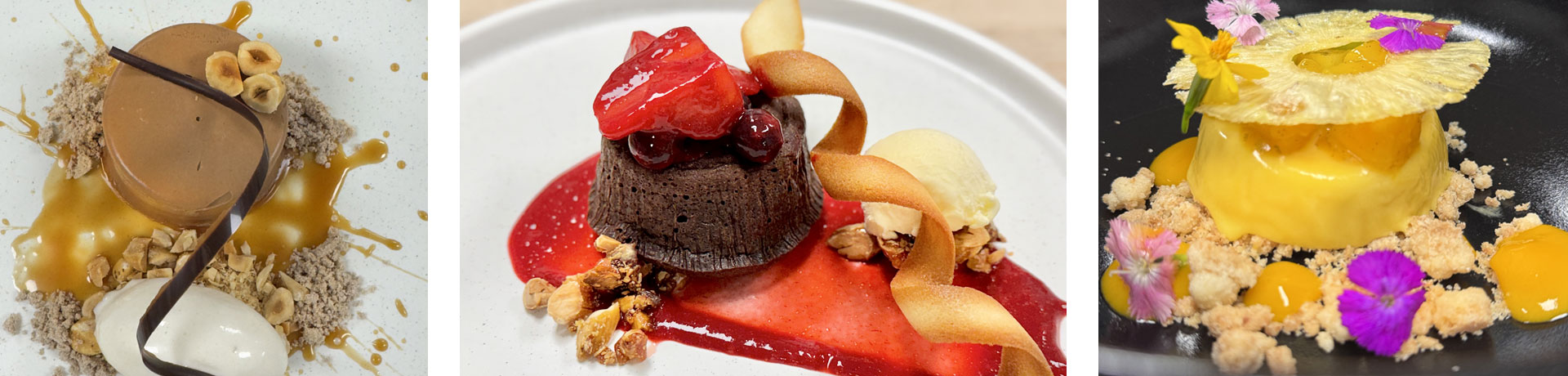
I had the opportunity to guide students through creating their own dessert concepts, whether for a restaurant or a food truck theme.
Watching them start with just an idea and then develop it into a plated dessert — thinking about flavor, texture, presentation and identity — was incredibly fulfilling. What made it even more special was seeing their confidence grow. At the beginning, many students hesitated, just like I once did. But by the end, they take ownership of their work, they express their creativity, and they begin to trust themselves. Being part of that transformation is what makes teaching so meaningful to me.
“Through this journey, I found my voice. Today, I can stand in front of students, guide them, support them and inspire them. That transformation is something I carry with immense pride.”
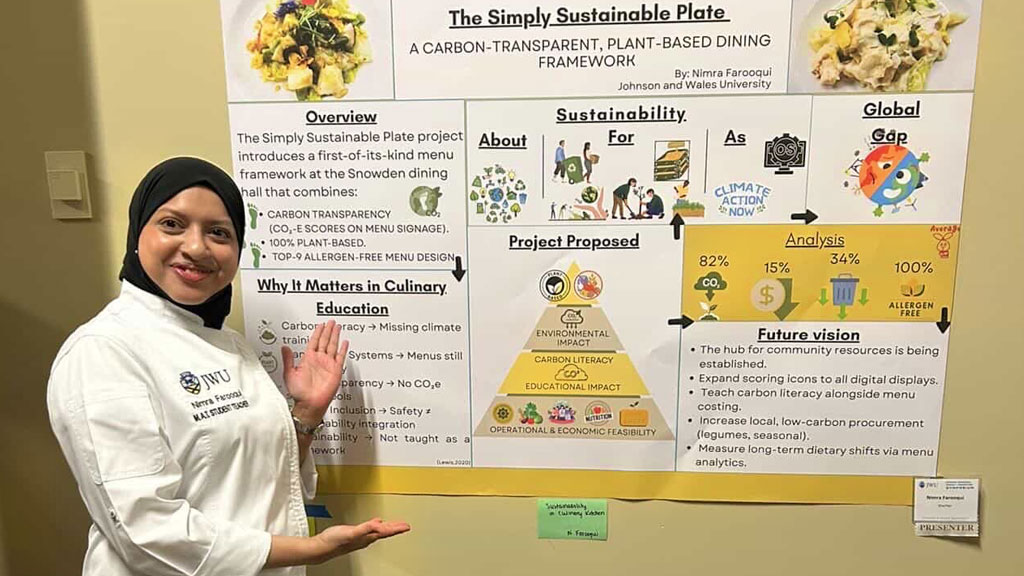
Your big MAT project is working on research and unit development for enhancing Foundations of Global Cuisine, as a way to help first-year students transition seamlessly into their sophomore studies. Briefly outline your research process for this program unit.
My research project focused on developing a unit around herbs and spices as a foundation of global cuisine, and this topic is very close to my heart because it reflects where I come from.
Growing up in India, spices were never just ingredients — they were a way of understanding food, culture, and tradition. When I had the opportunity to design my own unit, I wanted to bring that depth into the classroom. I structured it in a way that allowed students to engage with the material on multiple levels.
- I incorporated flipped classroom learning so they could explore foundational knowledge before coming to class.
- During in-class sessions, I used interactive lectures to connect those ideas with real-world applications.
- From there, we moved into kitchen demonstrations, where I showed how spices and herbs can be used intentionally, not just for flavor, but for balance and storytelling.
- Finally, students applied their learning through hands-on production, where they experimented and created their own dishes.
What I learned through this process is that teaching is not just about delivering content; it’s about creating experiences. … I realized that even the most well-planned lesson needs to be adjusted based on how students respond. Some concepts take longer to understand, some require different approaches, and some lead to unexpected but meaningful discussions. This process of observing, reflecting and refining helped me grow not only as an educator, but also as a learner.
As you complete your studies, what’s the biggest thing you’ve learned about yourself? How has this program helped you realize your personal goals?
The biggest thing I have learned about myself is that I am far stronger and more resilient than I ever imagined. There were many moments in this journey where I felt overwhelmed — adjusting to a new country, navigating academics, dealing with language barriers and balancing personal challenges. There were times when I questioned myself.
But I never gave up. I learned to trust the process, to have patience, and to believe that even difficult moments have a purpose. I learned that growth does not happen overnight — it happens through persistence, reflection and faith.
Today, I see myself in a completely different light. I see myself as a future pastry chef who wants to innovate and bring new ideas into the world of desserts. I see myself as an educator who wants to guide and inspire students.
And I see myself as a storyteller — someone who wants to share experiences, culture and knowledge through food. Most importantly, I have learned that it is okay to start small, to feel uncertain, and to struggle —as long as you keep moving forward. Because in the end, those struggles become your strength, and your journey becomes your story.
What has been your proudest moment at JWU? What piece of advice would you give to a student thinking about transitioning from an undergraduate degree directly into graduate study?
Through this journey, step by step, I found my voice. Today, I can stand in front of students, guide them, support them and inspire them. That transformation is something I carry with immense pride. But what makes me even more proud is the connection I build with my students. When they start to trust me, when they feel comfortable asking questions, when they grow in confidence — that is when I know I am making a difference.
My advice to students is simple, but powerful: Believe in yourself, even when it feels difficult. Growth is never comfortable — it comes with doubt, challenges, and moments of uncertainty. But those moments are necessary; they shape you into the person you are meant to become.
Related Posts
Culinary
Alumni
Hospitality & Business
How 3 JWU Alumni Helped Run FIFA World Cup 2026
Arts & Sciences
Alumni